July 27, 2026
1952 SOUTH AFRICA George VI 300th Cape Town SHIP Silver 5 Shillings Coin i109615

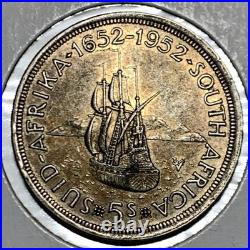
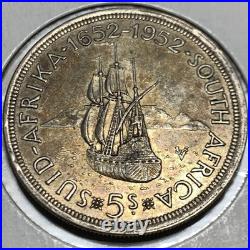
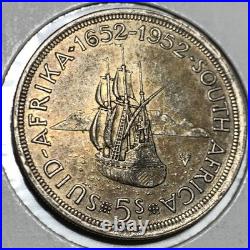
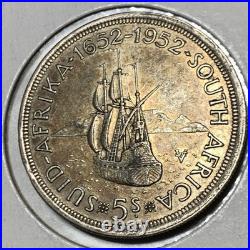
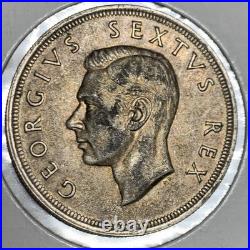
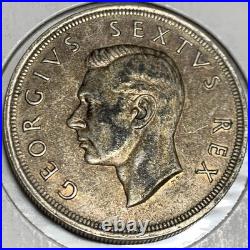
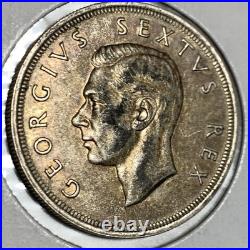
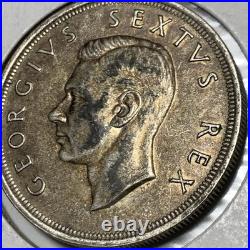

South Africa – under George VI – King: 11 December 1936 – 6 February 1952. 300th ANNIVERSARY of the Founding of CAPETOWN. 1952 Silver 5 Shillings 39mm (28.28 grams) 0.500 Silver 0.4517 oz. Obverse Designer: Engraver: T. GEORGIVS SEXTVS REX, His Majesty, King George VI of England, in profile facing. Table Mountain is in the background. Johan Anthoniszoon “Jan” van Riebeeck (21 April 1619 – 18 January 1677) was a Dutch navigator and colonial administrator who arrived in Cape Town in the Dutch Cape Colony at the behest of the Dutch East India Company. Jan van Riebeeck arrives in Table Bay in April 1652, painted by Charles Davidson Bell. Van Riebeeck was born in Culemborg, as the son of a surgeon. He grew up in Schiedam, where he married 19-year-old Maria de la Quellerie on 28 March 1649. She died in Malacca, now part of Malaysia, on 2 November 1664, at the age of 35. The couple had eight or nine children, most of whom did not survive infancy. Their son Abraham van Riebeeck, born at the Cape, later became Governor-General of the Dutch East Indies. Joining the Vereenigde Oost-Indische Compagnie (VOC) (Dutch East India Company) in 1639, he served in a number of posts, including that of an assistant surgeon in the Batavia in the East Indies. He was head of the VOC trading post in Tonkin, Indochina. In 1643, Riebeeck travelled with Jan van Elseracq to the VOC outpost at Dejima in Japan. In 1651, he volunteered to undertake the command of the initial Dutch settlement in the future South Africa. Van Riebeeck was Commander of the Cape from 1652 to 1662; he was charged with building a fort, with improving the natural anchorage at Table Bay, planting cereals, fruit, and vegetables, and obtaining livestock from the indigenous Khoi people. In the Kirstenbosch National Botanical Garden in Cape Town, a few wild almond trees still survive. The initial fort, named Fort de Goede Hoop (‘Fort of Good Hope’) was made of mud, clay, and timber, and had four corners or bastions. This fort was replaced by the Castle of Good Hope, built between 1666 and 1679 after van Riebeeck had left the. Van Riebeeck was joined at the Cape by a fellow Culemborger Roelof de Man 1634. Roelof came as the colony bookkeeper and was later promoted to second-in-charge. Van Riebeeck reported the first comet discovered from South Africa, C/1652 Y1, which was spotted on 17 December 1652. In his time at the Cape, Van Riebeeck oversaw a sustained, systematic effort to establish an impressive range of useful plants in the novel conditions on the Cape Peninsula – in the process changing the natural environment forever. Some of these, including grapes, cereals, ground nuts, potatoes, apples, and citrus, had an important and lasting influence on the societies and economies of the region. The daily diary entries kept throughout his time at the Cape (VOC policy) provided the basis for future exploration of the natural environment and its natural resources. Careful reading of his diaries indicate that some of his knowledge was learned from the indigenous peoples inhabiting the region. He died in Batavia (now renamed Jakarta) on Java in 1677. Legacy in South Africa. Jan van Riebeeck is of cultural and historical significance to South Africa. Many of the Afrikaner population view him as the founding father of their nation. This regard was also prevalent in that his image appeared ubiquitously on stamps and the South African currency from the 1940s up until 1993 when the South African Reserve Bank changed the currency to an apolitical design of the fauna and flora of the region. The image used on the currency notes was not that of Van Riebeeck, but of Bartholomeus Vermuyden. 6 April used to be known as Van Riebeeck’s Day, and later as Founders’ Day but the holiday was abolished by the ANC government after the elections of 1994. His image no longer features on any official currency or stamps, but statues of him and his wife remain in Adderley Street, Cape Town. The coat of arms of the city of Cape Town is based on the Van Riebeeck family coat of arms. Many South African towns and villages have streets named after him. Riebeek-Kasteel is one of the oldest towns in South Africa, situated 75 km from Cape Town in the Riebeek Valley together with its sister town Riebeek West. Hoërskool Jan van Riebeeck is an Afrikaans high school in Cape Town.